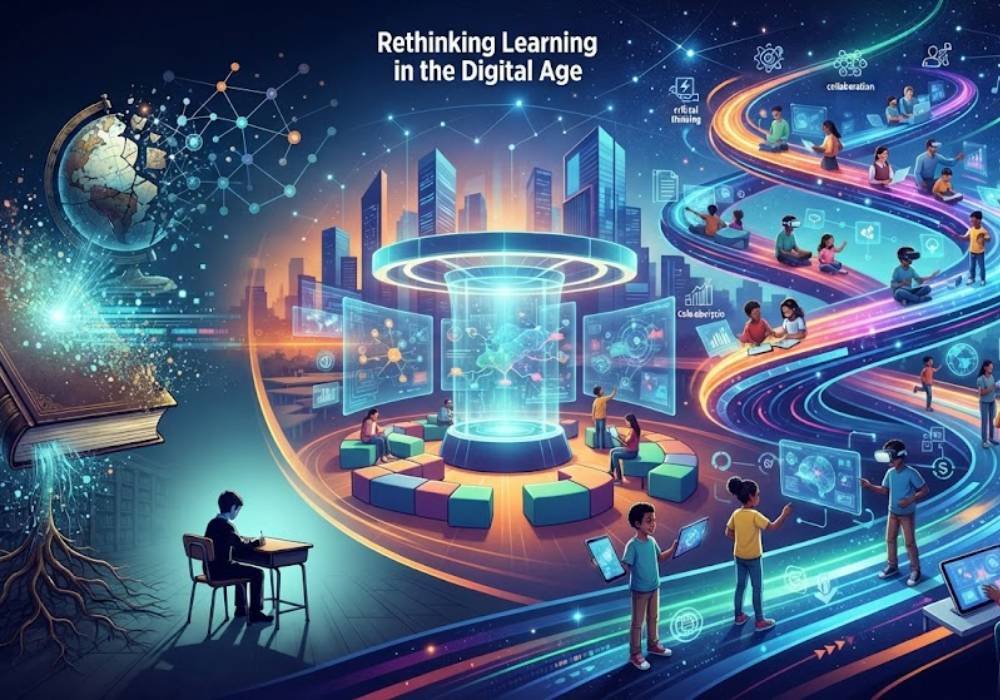
The digital age has transformed the way people access, create, and share knowledge. Technology has become an important part of education, changing traditional approaches to teaching and learning. Students can now access online courses, digital libraries, educational videos, virtual classrooms, and interactive learning platforms from almost anywhere. As a result, it is necessary to rethink learning and consider how education can respond effectively to the opportunities and challenges created by digital technology.
1. Changing Access to Knowledge
In traditional education, students often depended primarily on teachers and textbooks for information. Today, the internet provides access to an enormous amount of educational material. Digital libraries, online journals, open educational resources, and educational platforms allow learners to explore subjects beyond the limits of a physical classroom. This has made learning more flexible and accessible.
2. The Changing Role of the Teacher
Digital technology has changed the role of teachers. Teachers are no longer the only source of information. Instead, they increasingly act as facilitators, mentors, and guides who help students evaluate information, develop skills, and apply knowledge. Their role is particularly important because the abundance of online information makes it necessary for students to learn how to distinguish reliable information from misinformation.
3. Learner-Centered Education
The digital age supports more personalized and learner-centered approaches to education. Students can often choose learning materials according to their interests, abilities, and pace. Recorded lectures, interactive exercises, educational applications, and online courses can provide opportunities for students to learn in ways that suit their individual needs.
4. Development of Digital Literacy
Modern education requires more than traditional reading and writing skills. Students need digital literacy—the ability to find, evaluate, use, and communicate information through digital technologies. They must also understand issues such as online privacy, cybersecurity, misinformation, copyright, and responsible digital communication.
5. Critical Thinking in the Digital Environment
The large amount of information available online makes critical thinking more important than ever. Not everything published on the internet is accurate or trustworthy. Students need to question sources, examine evidence, identify bias, and compare different perspectives. Digital education should therefore encourage students not simply to consume information but to evaluate and interpret it critically.
6. Collaboration and Connectivity
Digital technologies have created new opportunities for collaboration. Students can work together through video conferencing, shared documents, discussion forums, and other online platforms even when they are physically separated. These tools can encourage communication, teamwork, and the exchange of ideas across geographical and cultural boundaries.
7. Challenges of Digital Learning
Despite its benefits, digital learning also creates challenges. Excessive screen time, distractions, unequal access to technology, reduced face-to-face interaction, and information overload can affect the learning experience. The digital divide is particularly important because students without reliable internet access or suitable devices may not benefit equally from technology-based education.
8. Rethinking the Purpose of Education
The digital age requires educators to reconsider what students should learn. Memorizing large amounts of information is less important when information can be accessed quickly. Greater emphasis can instead be placed on problem-solving, creativity, communication, collaboration, critical thinking, and the ability to apply knowledge to real-world situations. Education should prepare learners not only to use technology but also to think independently in a rapidly changing world.
Conclusion
In conclusion, the digital age has fundamentally changed the nature of learning. Technology has made education more accessible, flexible, collaborative, and personalized, but it has also introduced new challenges. Rethinking learning means finding a balance between technological opportunities and the human aspects of education. The goal should not simply be to use more technology, but to use it meaningfully to develop knowledgeable, critical, creative, and responsible learners who can adapt to a constantly changing world.